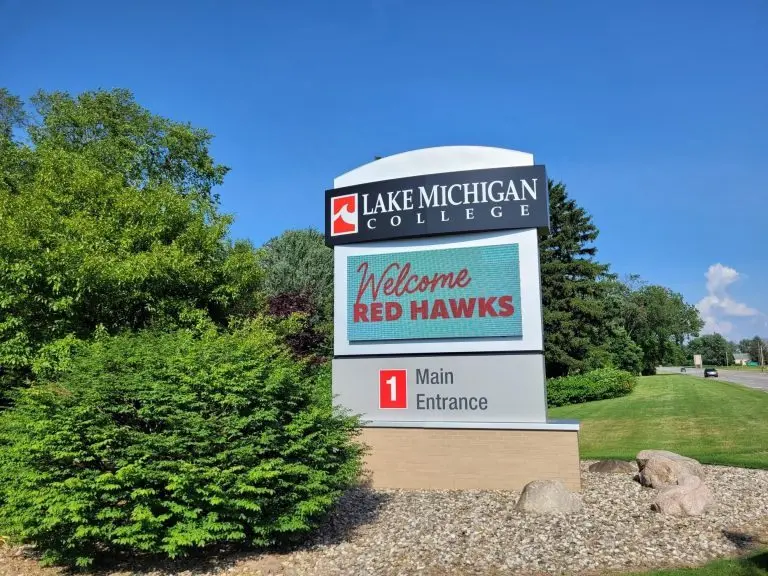
Lake Michigan College is touting some of the programs it offers to support the needs of students beyond the classroom as it seeks to enhance retention and help students graduate.
LMC Assistant Dean of Student Success Leslie Navarro tells us in the past year, the college has received $525,000 in the form of three grants to expand student support services and combat food insecurity across all three campuses. She says one grant, a MiLEAP Barrier Removal Grant of $400,000, has been used to expand mental health services.
“One of the biggest inputs that will come from that $400,000 grant is the addition of a digital mental health intervention tool, which we call the DMHI,” Navarro said. “We’ve partnered with Timely Care to provide that service for us on campus, and that’s a digital resource for mental health services that’s available to every registered student on campus. It allows them to access 24-7 crisis support through an app. It also allows them to access individual counseling services at any time.”
LMC this year has also received a $75,000 MiLEAP Hunger-Free Campus Grant to bolter programs like its food pantries and snack shacks, also available for students at all three campuses.
“We have a really robust pantry system on campus for students. Our Red Hawk Refuel Pantry provided over 12,000 items to students last academic year. In services, right around 400 individual unique students annually, fulfilling around 1,200 orders for those students.”
Navarro says helping students with things like mental health and hunger are now an essential part of running a community college.
“All of the data and research collected nationally and statewide and even locally tells us that mental health needs and basic needs and security issues for students are two of the predominant issues that lead students to stop out and not complete their degree.”
LMC has also received a $50,000 grant from the Michigan Community College Association Ohio-Michigan Pathways Together Initiative to help it better identify student needs. That will include the completion of a comprehensive student needs assessment, the development of a student success dashboard, and community partnerships.
“These basic needs issues that students run into — being hungry, having insecurity around housing, struggling with transportation, or having untreated mental health issues that they’re facing, are all issues that keep students from completing their degrees. And so I think it’s our responsibility institutionally to try to evolve and provide services that are targeting some of those areas that we know are hindering student completion rates.”
Navarro says all of these initiatives are just a part of being a well rounded community college that seeks to help its students succeed.
“We’re not only providing education. We’re doing that and we’re doing that well, but we’re also providing this student success center experience for students where they have a full ecosystem of care addressing all of the various barriers that students may encounter as they’re looking to complete their career.”