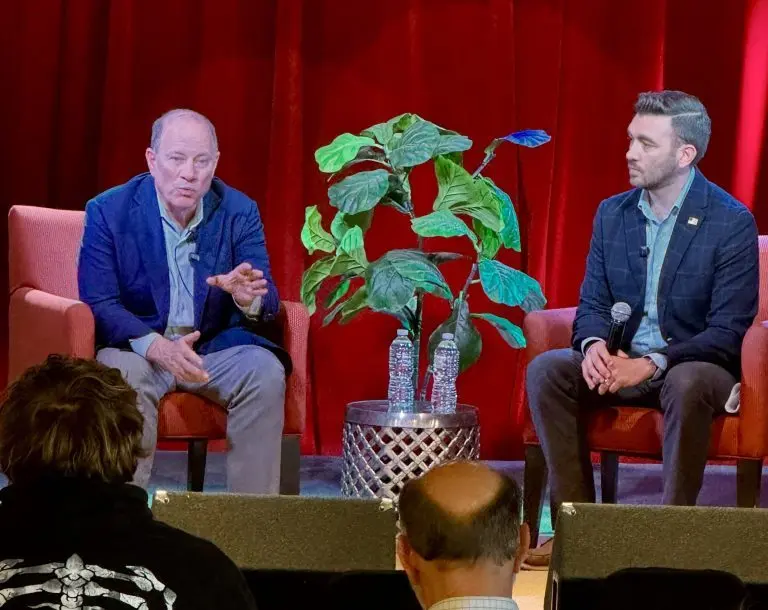
Former mayor and independent gubernatorial candidate Mike Duggan brought his statewide campaign tour to Southwest Michigan on Monday, making numerous stops in Berrien and Cass counties before speaking with residents at a town hall meeting in St. Joseph.
Duggan, the longtime mayor of Detroit, said his campaign is centered on direct conversations with voters across all 83 counties. “When you sit together and talk, we have much more in common than divides,” he said, noting that similar concerns are emerging statewide, including housing costs, workforce shortages, and regulatory delays affecting agriculture and development.
At a gathering organized by the Southwest Michigan Regional Chamber at The Box Factory, Duggan spoke to a group of about 80 people, identifying three main priorities driving his campaign: education, economic growth, and housing.
“Sixty percent of third graders don’t read at grade level,” Duggan said. “The Republicans and Democrats have done nothing about it.” He also pointed to job loss among younger residents, noting, “We lead this country in people under 30 moving out of state.”
Housing affordability, he said, is a major factor behind that trend. Duggan described hearing from communities across Michigan where young people cannot afford to live, including in Northern Michigan and other growing regions. “No matter where you go, young people are being priced out of this state,” he said, emphasizing the need to expand housing development to keep residents and attract new workers.
Duggan also referenced conversations with farmers during his visit, citing delays in irrigation approvals tied to staffing shortages at the Michigan Department of Environment, Great Lakes, and Energy. He said similar permitting issues have affected housing development in Detroit, pointing to what he described as a broader statewide challenge.
Data center discussion
On development issues like data centers, Duggan called for a four-point structure building stronger statewide standards with local control.
“One, (the) developer pays full freight for the electricity, it does not get passed on to the ratepayers. Two, the water is protected with closed-loop recycling. You can’t be putting that heated water back in to the environment. Third, it has to be transparent. This nonsense of redacting half of the agreements and saying to the public, ‘Don’t worry, you are protected.’ And then fourth, the local community has to make the decision. Nobody should be pressuring them or threatening to sue them.”
Duggan said he would send a legal team in to local communities to help define how data centers could and couldn’t develop.
“If you want a data center, let us show you the protections that other cities got. And if you don’t want a data center, we’re going to help you in fighting it. But we’re going to have a clear standard in this state for data centers development when I’m governor that makes sure that when they’re built, the public’s protected, and when the public doesn’t want them, that we turn them down.”
Duggan emphasized workforce development as key to reversing population loss, saying Michigan already produces talent but struggles to retain it. “Our problem isn’t that we don’t have the talent. Our problem is we pay to train the talent, the talent leaves.”
Navigating the Trump card
Running as an independent, Duggan said he would take a pragmatic approach to working with federal leaders. Asked how he would approach working with the Trump Administration, Duggan said he would approach on behalf of Michigan.
“When the president does something that’s good for Michigan, I’m going to support him… when he does things that are bad for Michigan, I’m going to speak out against him.”
A Michigan State University poll released Monday showed Duggan placing third in a three-way matchup between Democrat candidate Secretary of State Jocelyn Benson (30%), Republican Congressman John James (23%), and Duggan (19%), with 28% indicating other or undecided.
As an independent candidate, Duggan acknowledged he faces an uphill battle and will likely be outspent by both major parties. He said his success hinges on getting the word out about his candidacy, his record in Detroit, and what he’s seeking to do for Michigan.
“I’m having open community meetings in all 83 counties where Republicans and Democrats and independents all come together and I hope people will come out and just listen. And I want the skeptics, people who say, ‘How can an independent win?’ Because night after night, they all end up taking petitions and saying, ‘This is what we’ve been waiting for.’”